UWF-I Moving On (5.10.91) review
May 10, 1991
We’re in Tokyo, Japan at Korakuen Hall for the new*, NEW**, UWF. This time with an added I. It’s Union of Professional Wrestling Force INTERNATIONAL. When Maeda’s UWF splintered, after initially being a massive success, the three main guys all took their own different routes into shootstyle promotion. This is why shootstyle will never work as a mainstream thing by the way. No one can agree on how it’s presented. UWF’s collapse is a dramatic demonstration of this. Yoshiaki Fujiwara was the first to debut a new promotion; Pro Wrestling Fujiwara Gumi, which quickly got involved with SWS. Next up is Takada here with UWF-I. Finally, Akira Maeda will debut his Fighting Network Rings tomorrow. So, now the market is diluted into three. All Japanese promotions eventually splinter. It’s the nature of Japan. No one can agree on anything.
*Following UWF from the mid 1980s
** and also UWF Newborn from the past couple of years.
The presentation of this is interesting. We get little stills of Takada interspersed with him hitting strikes. Then we’re off to early in the day and we get a sports-style presentation. A few interviews, some training footage. There’s not a lot of matches on tonight’s card. We’re merely being introduced to the new concept. The best part of this is that they’ve retained the UWF music. AHHH, yes lads.
The Rules
We’ve changed the rules since the UWF. Previously you had a certain number of knockdowns and that led to crazy striking at the end of matches. Now the wrestler starts with 15 points. You lose points for being knocked down, being at a disadvantage in a hold or by using the ropes to escape a hold. You can win by submission, knockout, or losing all your points. It’s a similar design to the previous UWF system. There are no pinfalls in the UWF-I.
To demonstrate the rules, two young lions hop in and do some spots. It feels like the safety rules demonstration on a plane only with elbow strikes. The crowd are all “oooohhhhh, ok”.
Masahito Kakihara vs. Kiyoshi Tamura
I’ve seen Tamura a few times and boy, is he the real deal. Kakihara came through UWF late last year, so I’ve not seen him work before. The work here is so good. Kakihara lands a few strikes, so Tamura immediately takes him down to stop it but, in his rush, leaves his head too far forward and gets caught in a front choke, which he just about escapes. The logic and flow to all of this is exceptional.
Tamura does things you never usually see. Like blocking a takedown by slipping out of it. Kakihara finds himself at a disadvantage and is docked a point. Kakihara is an aggressive striker and often pushes Tamura into desperation takedowns. While Tamura can cope with Kakihara’s stand up, Kakihara struggles with Tamura’s mat excellence. Although he does force Tamura into the ropes for his first point loss.
The use of body shots to expose Kakihara’s neck shows how Tamura approaches fighting differently to anyone else. This is as close to MMA as we’ve seen so far. I like how the match completely devolves into wild swinging for the fences, and Kakihara eats a knock down to lose major points. Tamura sensibly ducking under a big kick and covering up. When a kick completely misses in this, it feels naturally part of the match.
It’s not elite shootstyle as Tamura leaves his leg in when applying holds, leaving Kakihara with an easy hold to escape. If it was a real shoot, he simply wouldn’t do that. Also, his covering up leaves him completely open to straight kicks and punches, but Kakihara just does wild spin kicks instead. A much better counter is Kakihara going for another high kick, and Tamura defensively stiff kicking him in the calf of the standing leg.
Tamura’s main tactic seems to be to deplete Kakihara’s points by putting him in holds and forcing him into the ropes. Kakihara wants a knock out. Kakihara makes the biggest error by countering a heel hook into one of his own, ignoring his ring position, thinking he can win. Tamura counters out back into the heel hook, and Kakihara is nowhere near the ropes. He’s forced to tap out. ***¾
This was a great demonstration of UWF-I rules and a spirited contest with two fighters applying their own techniques and tactics to proceedings. It was bordering on great but had a few wrinkles that needed ironing out. Tamura’s win is greeted by very loud cheers. He’s a huge fan favourite and a very skilled technician. What a start to UWF-I.
Yoji Anjo & Yuko Miyato vs. Kazuo Yamazaki & Tatsuo Nakano
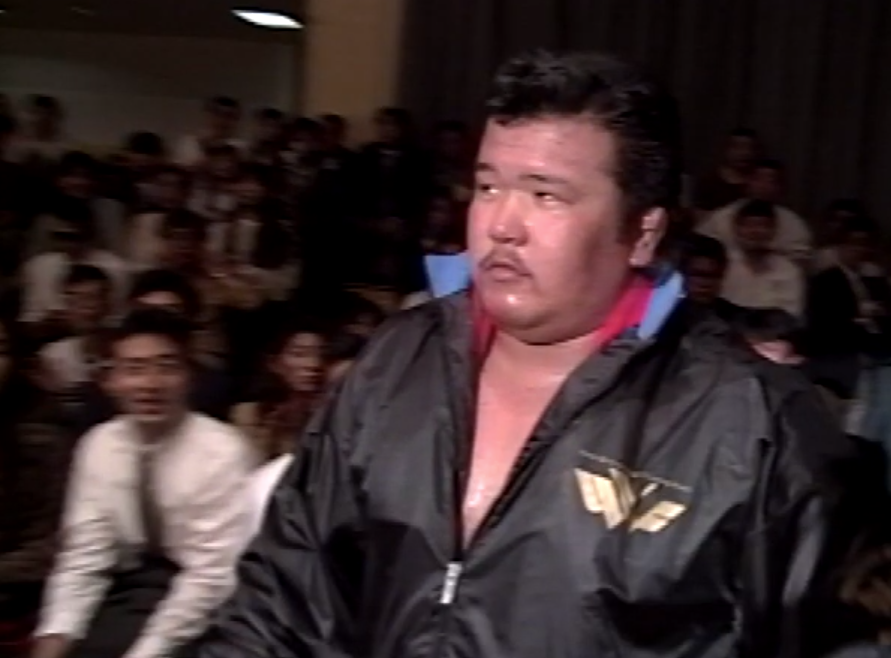
Now we get a demonstration of how tag teams work here. The points are up to 21. Nakano (above) is a pudgy underdog guy who I adore. He had a match with Masakatsu Funaki that was off the charts great in 1989. Any other year and it could easily have won MOTY. Miyato has changed his name from Shigeo to Yuko. Everyone in this was good for UWF.
The pairings in this are interesting as they’re either relatively even (Nakano vs Miyato) or someone is fighting from underneath (Nakano vs Anjo). Anjo & Miyato quickly establish that they’re better at being a team as Nakano is too stubborn and heroic to tag out. I love him. By contrast Yamazaki is clearly the big dog and the best all round worker in this.
Nakano accidentally kicks Miyato in the balls and there’s no penalty. We just give him a moment to recompose himself and tag out. I like that Anjo tries different approaches against the superior Yamazaki. He mixes up his style, his targets and his mentality to try and keep Yamazaki unbalanced. Everyone employs great strikes, but it’s Miyato who impresses the most. He slaps Nakano in his fucked up nose and it’s soon gushing blood.
Yamazaki decides he’s going to get revenge for his partner and kicks Miyato in the face. It’s not revenge until he’s bleeding Kazuo! Yamazaki’s kicks are a big highlight, as always. Everyone puts in a good shift and shows energy. It does drag a tad at 23:00, but everyone works hard and keeps it entertaining. Yamazaki gets himself isolated in the other corner and takes repeated downs as they take it in turns to kick his head in. Anjo is especially aggressive and you can sense the match is nearly over. Eventually an Anjo knee leaves Yamazaki unable to answer the count. ***
This was another very good demonstration of the new company and the style. Everyone was good here, but the match only took a higher gear right at the end. The matches are notably quicker in their pacing than in UWF. As if Takada wanted a more exciting product. I’m not complaining. Oddly enough Takada was one of the workers who was working at that slower pace.
Nobuhiko Takada vs. Thomas Burton
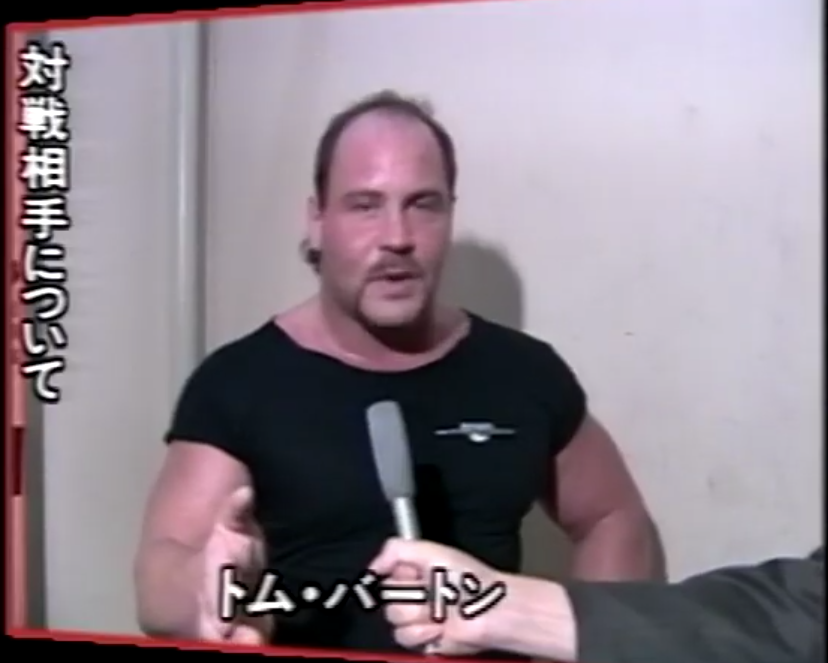
This is “Dirty” Tom Davis aka Tom Burton aka Beef Burton. He was trained by Brad Rheingans and comes from Minnesota. He’s a jobber stateside but cuts a promo suggesting American wrestling is superior to Japanese wrestling. Takada would take a shine to him and use him for five years. If I’m being polite…Burton isn’t on Takada’s level. His shoot work is loose and unconvincing. It makes Takada look worse because he doesn’t immediately cream him and the crowd clearly don’t give a fuck.
They patiently sit there and only pop when Takada lands the odd kick. Burton, a pro wrestler, decides he’s going to sell too. Walking around holding his arm so the crowd know he’s injured. Then hobbling around after Takada kicks his leg. Burton also has no idea where to go after takedowns. At one point lying on top like he’s pinning Takada and attempting nothing resembling a submission.
If there’s ever a match to demonstrate the difference between shootstyle and traditional pro-wrestling this is it because one guy is doing shootstyle and the other guy is doing traditional pro-wrestling. Burton is at his best taking a beating, because he’s a jobber. His big submission attempt is a half crab where he walks around Takada to hook it. Jesus. His secondary big submission attempt is a fucking full nelson.
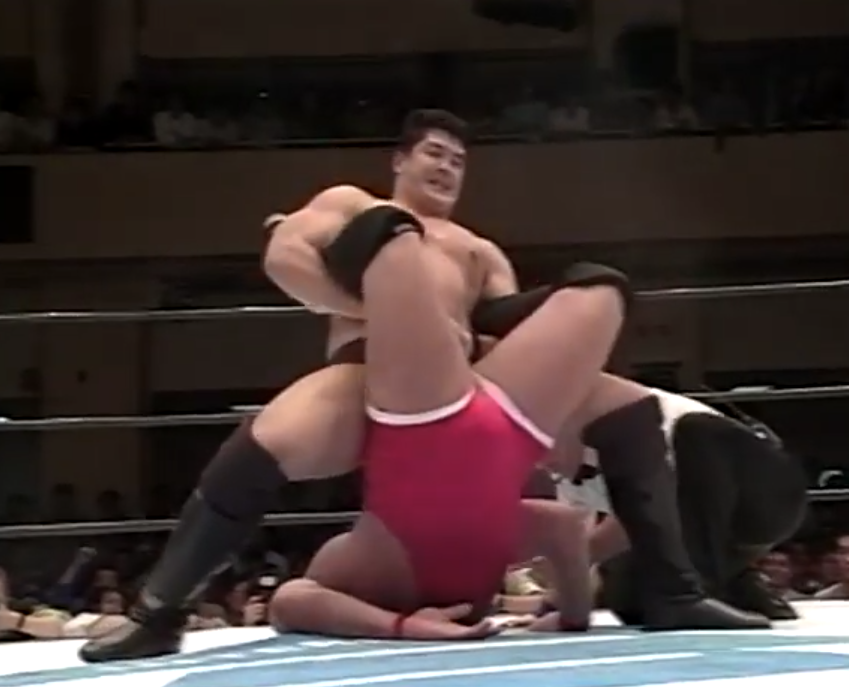
Takada fires up, hits a few palm strikes and finishes with the Boston crab. Boy….was this bad compared to everything else. Burton clearly didn’t have the necessary skills to get this over and resorted to pro-wrestling. Honestly though, this could have been far worse, but it’s not a great look for the ace of the promotion to be in the worst match of the opening night by a country mile. *¾
The 411:
UWF-I was a fresh start for shootstyle with Takada excited to implement the new rules he’d dreamed up. It worked really well for most of the night until his dubious decision to headline against a random Yankie jobber.
RINGS first show doesn’t appear to be online anywhere, but it featured a bunch of Dutch kickboxers and BILL KAZMAIER. Maeda beat Dick Vrij, a Dutch kickboxer, in the main event. While it’s clear the main events followed the same formula, the undercard for UWF is way better. Takada convinced more exciting native talent to work with him. Maeda’s show is, predictably, all about Maeda. And now we can see why the two didn’t want to work together anymore. However, Maeda has a secret weapon…Volk Han and he’s about to unleash him on an unsuspecting public.

 Twitter